Batman and Robin Death of the Family Joker Art
| "A Decease in the Family unit" | |
|---|---|
 Encompass of Batman #428 (October 18, 1988) Fine art by Mike Mignola | |
| Publisher | DC Comics |
| Publication appointment | Baronial – Nov 1988 |
| Genre |
|
| Title(s) | Batman #426–429 |
| Main character(south) |
|
| Creative team | |
| Author(southward) | Jim Starlin |
| Penciller(s) | Jim Aparo |
| Inker(s) | Mike DeCarlo |
| Letterer(due south) | John Costanza |
| Colorist(s) | Adrienne Roy |
| Editor(due south) | Dennis O'Neil |
| 2011 edition | ISBN 1401232744 |
"A Death in the Family unit" is a 1988 storyline in the American comic book Batman, published by DC Comics. Information technology was written by Jim Starlin and penciled by Jim Aparo, with cover art past Mike Mignola. Serialized in Batman #426–429 from August to November 1988, "A Death in the Family" is considered one of the almost important Batman stories for featuring the death of his sidekick Robin at the hands of his archenemy, the Joker.
Jason Todd, the second character to presume the Robin persona, was introduced in 1983 to replace Dick Grayson, who was unavailable for utilise at the time. Todd became unpopular amongst readers after 1986, as writers began to characterize him as rebellious and impulsive. Editor Dennis O'Neil was because having Todd revamped or written out of Batman when he recalled a 1982 Saturday Dark Alive sketch in which Eddie Murphy encouraged viewers to call the testify if they wanted him to boil a lobster on air. Inspired to orchestrate a similar stunt, DC set up a 900 number voting organization to let fans to decide Todd'southward fate.
"A Death in the Family" begins when Batman relieves Todd of his offense-fighting duties. Todd travels to the Middle E to find his biological mother, simply is kidnapped and tortured by the Joker. Batman #427 ends with the Joker blowing Todd up in a warehouse. Starlin and Aparo prepared two versions of the following issue: one that would be published if readers voted to take Todd survive, and another if he was to be killed. A narrow majority voted in favor of the latter, and Batman #428 features Batman discovering Todd's lifeless trunk in the warehouse ruins. The storyline ends when Batman and Superman stop the Joker from killing the United nations Full general Assembly.
The story was controversial and widely publicized; despite Todd'due south unpopularity, DC faced backlash for the decision to kill ane of its most iconic characters. Todd'south demise had a lasting effect on Batman stories, with Batman's failure to save him pushing the comic volume mythos in a darker direction. Tim Drake succeeded Todd equally Robin in 1989, and Todd was resurrected as the Carmine Hood in the "Under the Hood" (2004–2006) storyline. "A Decease in the Family" remains a pop story among readers and has been reprinted in trade paperback course since its initial publication. Plot elements have been incorporated into Batman films, tv set series, and video games. An animated interactive picture adaptation, Batman: Death in the Family, was released in 2020.
Publication history [edit]
Background [edit]
[The fans] did hate [Jason Todd]. I don't know if it was fan craziness—maybe they saw him as usurping Dick Grayson's position... Information technology may be that something was working in the writers' minds, probably on a hidden level. They made [Todd] a little chip more disagreeable than his predecessor had been. He did go unlikeable and that was non any doing of mine.
Dennis O'Neil on Jason Todd's unpopularity[ane]
Robin, the adolescent sidekick of the DC Comics superhero Batman, beginning appeared in Detective Comics #38 in April 1940. He was introduced by Bob Kane, Beak Finger, and Jerry Robinson to give Batman a companion and increase his appeal to children.[2] The original Robin, Dick Grayson, made regular appearances in Batman publications from 1940 until the early 1980s, when Marv Wolfman and George Pérez began including him in the New Teen Titans comics.[3] Equally this made Grayson unavailable to the Batman comics, Batman author Gerry Conway and creative person Don Newton introduced Jason Todd in Batman #357 (March 1983).[4] Wolfman and Pérez had Grayson ready aside the Robin identity and become the independent superhero Nightwing in Teen Titans, while Todd became Robin in the Batman family of comics.[4] [five]
Originally, Todd'southward origin story was virtually identical to Grayson'south; similar Grayson, Todd was depicted equally the son of circus acrobats, who became Batman's sidekick later his parents were murdered.[five] Dennis O'Neil, who wrote Batman and Detective Comics throughout the 1970s and became the Batman group editor in 1986, said that Conway and Newton "[weren't] worried about creating a new grapheme. I recollect they thought, 'Nosotros've got to have a Robin in the series and so let'southward go with the tried and truthful. This Robin has worked for so many years, so allow'south exercise him again.'"[one] Following the Crunch on Infinite Earths (1985–1986) crossover effect, which rebooted the DC Universe,[a] Batman writer Max Allan Collins was asked to reintroduce Todd.[four] Batman #408 (June 1987) began a four-issue story by Collins and creative person Chris Warner that reimagined Todd every bit a street delinquent whom Batman attempts to reform.[half dozen]
The revamped Todd was unpopular amidst readers, who disliked his rebellious, impulsive nature.[7] A scene in Batman #424 (June 1988) in which Todd seemingly breaks Batman'southward no-kill rule and lies about it was particularly controversial.[viii] After Collins quit over creative differences, writer Jim Starlin and penciler Jim Aparo took over Batman.[four] Starlin did not like Todd and initially avoided featuring him, but began to use him in stories at the asking of O'Neil. Starlin "decided to play on that dislike" in his stories.[9] Past 1988, the Batman creative team knew Todd presented a problem that needed to exist resolved.[ane]
Development [edit]

Jim Starlin (pictured in 2008) proposed killing Robin half dozen months before he was asked to write "A Expiry in the Family".
O'Neil decided that Todd either needed another personality revamp or to be written out of Batman.[10] Around that time, DC was planning to publish a comic promoting HIV/AIDS education, and requested that writers submit suggestions for characters to kill off from AIDS. Starlin filled the suggestion box with proposals to kill off Todd, only DC staff rejected the idea later on realizing all the papers had Starlin'due south handwriting.[11] DC president Jenette Kahn wanted to address Todd'due south unpopularity.[4] O'Neil and Kahn attended an editorial retreat, where O'Neil recalled a 1982 Saturday Nighttime Live sketch in which Eddie Potato encouraged viewers to call one of two 900 numbers if they wanted him to boil a lobster on air. The sketch garnered widespread publicity and nearly 500,000 viewers called in.[12] O'Neil proposed a similar stunt involving 1 of the DC characters, which Kahn found intriguing.[1] [thirteen]
O'Neil decided that Todd was "the logical candidate to be in peril", as he was unpopular and placing him in such a situation would take massive ramifications.[1] "We didn't want to waste product it on anything pocket-size", he said. "Whether Firestorm's boots should be ruddy or yellow ... This had to exist important. Life or death stuff."[13] Kahn added that they wanted to permit fans to have input in what to exercise with Todd, rather than "autocratically" writing him out and replacing him.[4] The idea of having fans call to influence the creative process was a novel concept at the time, and DC's sales and marketing vice president Bruce Bristow described setting up the numbers as the about difficult function of the projection. Sales managing director John Pope began calling AT&T to secure the two 900 numbers on October 1, 1987; it took him until March 1988 to reserve them.[14]
Half-dozen months after Starlin proposed killing Todd, O'Neil asked him to start working on a potential story.[11] Starlin decided to take the Joker murder Todd, inspired by The Dark Knight Returns (1986), a limited serial by Frank Miller that featured Batman retiring after the Joker kills Robin.[9] Starlin wrote scripts for a half-dozen-upshot story,[iv] and the decision was made to combine the first iv across ii problems to speed upwards the story because fans were participating.[14] Aparo, inker Mike DeCarlo, and colorist Adrienne Roy provided the art, and assistant editor Dan Raspler suggested Mike Mignola as the storyline's cover artist.[4] Batman #427 features Batman arriving at a warehouse where Todd is imprisoned just as it explodes. On the back cover, an advertisement featured Batman carrying a severely wounded Todd. Readers were warned that Todd could die of his injuries, but that they could "preclude information technology with a telephone phone call". Two 900 numbers were given: one (1-(900) 720-2660) which would let Robin live, and another (1-(900) 720-2666) which would cause him to die. The numbers were activated for 35 hours in the United States and Canada from 9:00a.m. Eastern Standard Time on September 15, 1988.[thirteen] [four]
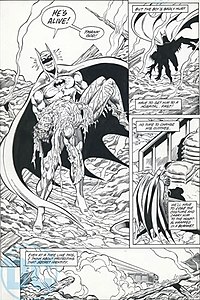

Artwork from the unpublished (left) and published (right) versions of Batman #428, showing the two planned scenarios. Considering readers voted to kill Todd, the left page went unpublished. Art by Jim Aparo, Mike DeCarlo, and Adrienne Roy.
Starlin and the artists prepared two versions of Batman #428, depending on the consequence.[11] As O'Neil stated, "It actually could take gone either manner. We prepared two choices of balloons. We had alternate panels. Nosotros had everything set so that the two outcomes could be accomplished with a minimum of changes. We prepared for either state of affairs."[14] Raspler explained that Aparo prepared iii alternate pages and several panels with static images that could be easily rearranged.[iv] O'Neil voted to permit Todd live, as he felt killing the character would complicate his job equally an editor,[14] and Starlin was unable to vote because he was in Mexico at the time.[xi] O'Neil and Raspler checked the results every 90 minutes.[14] DC executive editor and vice president Dick Giordano expected readers to vote in favor of Todd's survival; O'Neil believed they would vote for his death to run across if DC would follow through.[ten]
The poll received 10,614 votes and v,343 voted for Todd'south expiry over 5,271 for his survival—a margin of just 72 votes.[4] [fourteen] Although Kahn dispelled rumors that the process was rigged in favor of Todd's demise,[four] O'Neil said it was possible many votes favoring Todd's death came from a single person. He recalled hearing that "a lawyer programmed his Macintosh to dial the killing number every few minutes", but had no bear witness.[10] O'Neil canceled a party he planned to throw one time the verdict was in and decided to go on the result secret until Batman #428 was shipped. O'Neil did not tell his married woman, Starlin, or Aparo.[14] Starlin had expected Todd to die merely was surprised by how shut the vote was.[eleven] Production director Bob Rozakis supervised Roy equally she finished coloring, and and so had Steve Bove take the "existent" Batman #428 to finish it in the secrecy of his basement.[xiv]
Publication [edit]
"A Death in the Family" was published when Batman was surging in popularity. Post-obit the success of The Night Knight Returns and the "Year One" (1987) storyline, monthly sales for Batman were at their highest level since the early 1970s, and Tim Burton'southward Batman (1989) characteristic picture show was in production.[four] DC appear "A Death in the Family" shortly afterwards the release of the critically acclaimed graphic novel Batman: The Killing Joke in 1988; co-ordinate to author Chris Sims, the Batman letter cavalcade immediately "broke out into debate" over whether Todd should live or dice.[eight]
Batman #426, the outset upshot of "A Death in the Family", was released on August 23, 1988, and Batman #427, the 2nd, was released 2 weeks afterward, on September vi.[4] Fans voted to determine Todd's fate between September xv and 16, 1988, and Batman #428, which featured Todd's death, was released on October eighteen, 1988.[4] The storyline concluded with Batman #429, on November 29, 1988.[iv] The last two bug contained a guest appearance from Superman.[iv] After the start three issues of "A Decease in the Family" sold out, DC compiled the storyline into a trade paperback in fourth dimension for the 1988 Christmas shopping season. The collection, Batman: A Death in the Family, shipped on Dec v, 1988, less than a week afterward Batman #429.[4] A 2009 hardcover reprint included Wolfman, Pérez, and Aparo's 1989 sequel storyline, "A Lonely Identify of Dying", which introduced Todd's successor Tim Drake.[xv] A hardcover palatial edition was published in Apr 2021.[xvi]
For many years, the version of Batman #428 in which Todd lives remained unpublished, though the pages remained housed in DC's archives in Burbank, California.[17] Batman Almanac #25, published in March 2006, used 1 of the alternate pages Aparo had prepared;[16] some panels were released by Les Daniels in his book Batman: The Complete History (1999) and by Polygon journalist Susana Polo in 2020.[17] In March 2020, the DC Daily spider web show unveiled all of the pages to the public for the first time,[eighteen] and the artwork was published in the 2021 deluxe edition.[xvi]
Synopsis [edit]
While eavesdropping on a child pornography ring and awaiting police backup in Gotham City, Jason Todd (Robin) ignores Batman's orders and attacks the criminals. Batman chastises Todd and asks if he considers crimefighting a game; Todd replies that life is a game. At Wayne Manor, Batman decides Todd is emotionally unstable and relieves him of his duties as Robin; an enraged Todd storms off. Meanwhile the Joker, Batman's archenemy, escapes from Arkham Asylum. Batman discovers that he has obtained a nuclear weapon and plans to sell it to terrorists, and tracks him to state of war-torn Lebanese republic.
Walking through his sometime neighborhood, Todd meets a friend of his late parents, who gives him his father's old documents. Todd discovers that his female parent's name on his birth certificate is blotted out, and that her first initial is "S", non "C" as in Catherine Todd, the woman he knew equally his mother. Todd concludes that Catherine was his stepmother and decides to search for his biological mother. He uses the Batcomputer to track three possible individuals to the Middle East and Africa. Todd travels to Lebanon, where he and Batman reunite. The 2 foil an try by terrorists to destroy Tel Aviv using the nuclear missile purchased from the Joker. Batman agrees to help Todd notice his mother, and Todd interrogates his outset suspect, Mossad agent Sharmin Rosen. His next suspect is Batman's old acquaintance Lady Shiva, who says she is non Todd's mother after she is administered a truth serum by the duo.
Batman and Todd travel to Ethiopia and ostend that Todd's mother is Sheila Haywood, an aid worker; Todd has an emotional reunion with her. Yet, the Joker discovers that Haywood had performed illegal surgeries on teenagers in Gotham and has been blacklisted as a medical practitioner. The Joker uses this information to blackmail her into giving him the medical supplies her bureau has stockpiled in a warehouse. He sells them on the black market and stocks the warehouse with Joker venom, which will impale thousands of people. Haywood has likewise been embezzling from the aid agency and, as office of a cover-upwards, hands Todd, in his Robin costume, over to the Joker. The Joker beats Todd with a crowbar and restrains him and Haywood in the warehouse with a time bomb. Todd throws himself on the bomb to shield Haywood as the warehouse explodes. Batman arrives too late to relieve them, and Todd and Haywood dice from their injuries.
Traumatized, Batman takes Todd and Haywood'due south remains to Gotham and holds a burial with Alfred Pennyworth, Commissioner James Gordon, and Barbara Gordon. Batman blames himself for Todd's death and resolves to carry on alone, rejecting Pennyworth'due south proposition to involve Dick Grayson, the kickoff Robin. The Joker meets with Ayatollah Khomeini, who offers him a role in the Iranian regime. The Joker leaves a warehouse containing the corpses of his henchmen and the accost of the UN Headquarters for Batman. As Batman waits outside the UN building, Superman appears and tries to convince Batman to exit. The Joker is Iran's representative to the UN and will be giving a voice communication on the floor of the General Assembly, and whatever confrontation between Batman and him could start a diplomatic incident.
During his speech, the Joker attempts to poison the entire bedchamber with Joker venom, simply Superman intercepts the gas. Batman pursues the Joker onto a helicopter sent by his sponsors. During the resulting struggle, 1 of the Joker'southward henchmen opens fire with a automobile gun and shoots the pilot, crashing the helicopter into the sea. Superman saves Batman, only the Joker's torso is not establish. Batman laments that everything between him and the Joker ends unresolved.
Reception [edit]
Initial [edit]

Editor Dennis O'Neil (pictured in 2012) proposed that DC allow fans to decide if Todd was to die.
The first iii chapters of "A Death in the Family" sold out quickly,[4] and according to Starlin, the storyline was DC'south bestselling comic of 1988.[19] The storyline drew coverage in news outlets including USA Today, Reuters, and the Deseret News.[20] [21] Many reports did non mention that Todd was non the original Robin.[twenty] As an editor at Curiosity Comics, O'Neil had received angry mail service from fans when characters such as Phoenix and Elektra were killed, so he was prepared for reader backlash to Todd's decease. Nonetheless, "A Death in the Family" created much more than controversy, as Robin was 1 of DC's nearly iconic characters and the Curiosity deaths had occurred during a menstruum of recession in comics.[xx]
O'Neil spent the days following Batman #428'southward publication "doing nothing but talking on the radio. I thought it would get united states of america some ink hither and there and mayhap a couple of radio interviews. I had no idea—nor did anyone else—it would take the effect it did."[1] After iii days, Peggy May, DC's publicity manager, ordered O'Neil to terminate talking to the media. She as well barred anyone from discussing the story on television. Though initially dislocated, O'Neil came to appreciate May's order because he did not want the public to see him as "the guy who killed Robin".[i] Assistant editor Dan Raspler was chastised by DC's then-executive vice president Paul Levitz for referring to "A Decease in the Family unit" as a "stunt" in an interview.[four]
Todd'southward death divided fans at the fourth dimension.[viii] Many readers celebrated, some hoping information technology meant that Grayson could go Robin again. Others lamented how bloodthirsty comic book readers were.[8] [22] O'Neil and the Batman team received hate postal service and angry phone calls; according to O'Neil, the calls ranged from "'You bastard,' to tearful grandmothers saying, 'My grandchild loved Robin and I don't know what to tell him.'"[ane] Frank Miller was critical, calling the story "the most cynical affair [DC] has ever washed ... fans tin call in to put the axe to a little boy's head. To me the whole killing of Robin matter was probably the ugliest matter I've seen in comics".[23] NPR cultural critic Glen Weldon constitute the criticism to exist ironic, as it was Miller who came upwards with the thought of the Joker killing Todd in The Dark Knight Returns.[24]
Retrospective [edit]
Critics have agreed with the decision to kill Todd in retrospect.[viii] [24] [25] Sims wrote that killing Todd was "unquestionably the right conclusion" and made for a far ameliorate story.[8] He opined that allowing the Joker to defeat Batman enhanced both characters: the Joker became "a deadly threat... whose actions take lasting consequences", while Batman had "a motivating loss at a time when new readers were coming in".[8] Hilary Goldstein of IGN and Jamie Hailstone of Den of Geek praised the story's handling of Todd'south death for its emotion and portraying the dangers of superheroics.[25] [26]
Retrospective reviewers accept faulted "A Decease in the Family unit" for its plot.[25] [26] [27] Hailstone described "A Death in the Family unit" as "the ultimate 80s ballsy": "brasher than Acme Gun, louder than Hulk Hogan and more implausible than The A-Team".[26] Both Hailstone and Goldstein found the plot hard to believe,[25] [26] and Hailstone said that it veers into nonsense when the Joker is appointed equally an ambassador.[26] Charles Prefore, writing for Screen Rant, said the story "can't decide if information technology wants to be fun or dark"; while Todd's torture and death at the easily of the Joker is quite somber, elements like the "globetrotting nature of the story" and the Joker condign an ambassador for Iran are evocative of the goofy Silvery Historic period of Comic Books. Prefore said the story'due south grim moments, which caused "A Death in the Family" to gain a reputation equally 1 of the darkest Batman stories, overshadow the remainder of its outlandishness.[27]
"A Decease in the Family" remains a popular story amid readers,[22] and despite their reservations over the plot, critics withal deemed information technology worth reading.[25] [26] [27] Hailstone called the story a "guilty pleasure" that, while not as groundbreaking as "Year One" or Batman: Son of the Demon (1987), was entertaining even so,[26] and Prefore summarized it as "a good read if you don't mind all the strangeness".[27] Publications ranking it among the best Batman stories include IGN and Circuitous in 2014,[28] [29] and GamesRadar+ and Screen Rant in 2021.[xxx] [31] Sean T. Collins of Rolling Rock ranked it among the 15 Batman stories he considered "essential" to understanding the character, praising Aparo's fine art and how Starlin characterizes the Joker.[32]
Literary analysis [edit]
Despite Robin's condition as one of the about famous sidekicks in comic book history, there has been little literary analysis of "A Death in the Family".[33] Co-ordinate to literary critic Kwasu Tembo, information technology is generally just discussed "every bit either a case report within a broader discussion of Batman's ideals, or as a instance study of DC'southward editorial decisions and socio-historical engagement with its readership".[34] The story'south message is that Batman cannot relieve everyone,[viii] and it portrays Todd as a tragic figure whose sympathetic journey ends in death.[35] Tembo contended that the expiry leaves the reader to ponder Todd's nature as "Batman's greatest failure, as an orphan betrayed, and/or equally a careless and overzealous lost boy who reaped what he had so impulsively and thoughtlessly sown".[36]
Tembo theorized that Todd'due south death, every bit voted for past readers, "can exist more thoroughly understood as a complex form of scapegoating", comparable to a public execution.[37] Todd was unpopular because he struggled to live up to the standard of his predecessor Grayson, which fabricated him a "bad" Robin.[38] This created jealousy amidst readers, who concluded that Todd was unfit to be Robin.[39] Citing René Girard'due south theory of mimetic desire, Tembo wrote that O'Neil's decision to let fans determine Todd'south fate created a "mimetic crunch" because readers "could at present non just influence [Todd's] existence in the story world, but in being given this power, compete against him".[40] Readers instead saw themselves as more fit to be Batman'southward partner; by voting to kill Todd, they thought they were helping Batman.[41] Tembo points out that the closeness of the vote indicates that fans may not have despised Todd as much as commonly believed. Fans who voted to save Todd may take voted to preserve the classic status quo, or because they plant the Joker's murdering a child during an emotional period in his life unsettling.[37]
Delineation of Islam [edit]
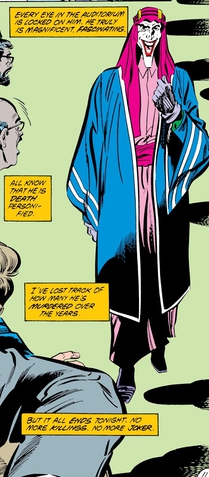
As an Iranian ambassador, the Joker wears a traditional Arab headdress and robes although Islamic republic of iran is not an Arab state.[42] Art past Jim Aparo, Mike DeCarlo, and Adrienne Roy
"A Death in the Family" has been criticized as Islamophobic for its portrayal of Arab terrorists. The terrorists are portrayed as anti-American, anti-Israel fanatics who seek to violently take over the Western world.[43] [44] They are referred to as "bandits-in-bedsheets" and depicted equally unshaved and always holding weapons, while Jamal, the terrorist leader, is overweight and perpetually sneering.[45] In a 1991 study of Arab terrorist depictions in comic books, Jack Shaheen wrote that "A Decease in the Family" conflates Arabs, Muslims and terrorists, and equates them to the Joker, an insane supervillain.[45] Jehanzeb Dar and Shaheen cited the Joker's speech to the General Assembly as a particularly egregious instance of Islamophobia in "A Expiry in the Family".[45] Earlier he attempts to poison the chamber, the Joker gloats:
I am proud to speak for the great Islamic Republic of Iran. That country's electric current leaders and I take a lot in common. Insanity and a slap-up love of FISH. Only unfortunately we share a mutual trouble. We go NO RESPECT. Everyone thinks of Islamic republic of iran as the dwelling of the TERRORIST ZEALOT! They say even worse things about ME, would yous believe? We've both suffered unkind Abuse AND BELITTLEMENT! WELL, WE AREN'T GOING TO Have IT ANYMORE!! Y'all'll no longer be allowed to kicking us effectually. In fact, you aren't going to exist able to kick ANYONE around ever again!
—The Joker, Batman #429
Dar described the Joker'south oral communication as blatant Islamophobia bearded equally humor.[42] Shaheen and Dar argued "A Death in the Family" promotes the idea of "Them vs. United states", pitting the Arab and Western worlds confronting each other equally diametrically opposed in values.[42] [45] The story contains errors in its depiction of the Heart East. Starlin writes Batman equally speaking Farsi, the Western farsi linguistic communication, in Beirut (where Arabic is actually the commonly spoken linguistic communication), and the Joker dons a traditional Arab headdress and robes equally the Iranian ambassador, although Iran is not an Arab state.[42] Dar ended that "[Starlin]'southward and [DC]'s disregard for cultural, religious, and political accuracy simply points to a crude and racist generalization: Arabs, Iranians, and Muslims are all the 'same' and 'detest' the West."[42]
Legacy [edit]
"A Expiry in the Family unit" was function of the American comic volume industry'south trend towards "grim and gritty" comics in the belatedly 1980s,[24] [22] and is remembered as ane of DC's most controversial storylines.[46] [47] Chris Snellgrove of Looper described the scenes depicting Todd'due south torture and expiry—with the Joker covered in his claret— every bit "one of the most disturbing moments in the publisher'southward long history".[48] DC editors took the lessons they learned from the controversy and used media coverage for publicity when killing off major characters in the hereafter,[49] such as Superman in "The Death of Superman" (1992–1993).[fifty]
Although "A Death in the Family" sold well, it harmed Starlin's continuing at DC. DC'southward licensing department was infuriated over the death considering of the amount of trade—such as lunchboxes and pajamas—that bore Robin's likeness. Co-ordinate to Starlin, "everybody got mad, and they needed somebody to blame—and so I got blamed."[nineteen] Piece of work apace declined for him, and within six months he departed DC and returned to Marvel Comics, where he wrote The Infinity Gauntlet (1991).[11]
Effect on hereafter stories [edit]
"A Death in the Family" is regarded every bit ane of the almost important Batman comics for its event on hereafter Batman stories.[51] [52] The story contradistinct the DC Universe: instead of killing anonymous bystanders, the Joker murdered a core grapheme in the Batman fiction.[53] Aslope The Killing Joke (which featured Barbara Gordon, Batgirl, existence shot in the stomach and paralyzed) and the success of the 1989 Batman picture, "A Decease in the Family" pushed the Batman mythos in a darker management.[four] It portrayed Batman as more than violent and emotional following Todd's death, and for the next decade of comic book canon, he was haunted by his failure to save him.[54] Conway felt that the storyline allowed for "the entrance of the existent 'Nighttime Knight', the idea of Batman every bit the pitiless enforcer of Gotham".[55] When the DC Universe canon was rebooted during DC'southward 2011 New 52 reboot, the events of "A Death in the Family" were left intact because DC editors deemed information technology too important.[56]
Todd was likely to be replaced equally Robin regardless of his survival. O'Neil wanted to wait a year for a successor, only DC management demanded a new Robin immediately. O'Neil and Wolfman began developing the graphic symbol of Tim Drake, who debuted in the 1989 storyline "A Solitary Identify of Dying" by Wolfman, Pérez, and Aparo. O'Neil bundled for a nuanced introduction that explained why Batman would need a new sidekick afterward Todd'due south decease, and Drake was designed to appeal to both Todd's fans and detractors.[58] Drake proved popular and starred in several limited series and a 1993–2009 ongoing serial,[58] [59] until he was replaced by Damian Wayne in 2009.[60] Wayne shared Todd'due south willingness to become confronting Batman'southward wishes and use lethal force;[61] Grant Morrison and Frazer Irving'south Batman and Robin #xiii (2010) featured a scene in which Wayne beat the Joker with a crowbar, paralleling Todd's murder.[62]
Throughout the 1990s and early 2000s, Todd's death was i of the few comic book deaths that remained unreversed. Unlike traditional comic book deaths, Todd's was intended to stay permanent; at the time of "A Expiry in the Family unit"'s publication, O'Neil said that "it would be a really sleazy stunt to bring him back".[63] A popular aphorism among comic volume fans was that in comics, no characters stayed expressionless except Bucky Barnes, Uncle Ben, and Todd.[64] (Marvel would revive Barnes in 2004 as the Winter Soldier.[65]) Todd'southward revival was first teased in the "Hush" (2002–2003) storyline by Jeph Loeb and Jim Lee, which features Clayface impersonating an undead Todd to taunt Batman.[54] After writer Judd Winick read "Hush", he wondered why DC never revived Todd.[viii] Winick and creative person Doug Mahnke'southward 2004–2006 storyline "Under the Hood" revived him as the murderous vigilante Red Hood; the in-universe explanation for Todd's revival was that he was restored to life afterwards Superboy-Prime number punched the wall of a pocket dimension.[54] Todd eventually re-joined Batman'due south supporting cast as an "on-again, off-again ally",[eight] and starred in the series Ruby-red Hood and the Outlaws (2011–2021).[66] Despite his resurrection, in 2020 journalist Susana Polo noted Todd was still well-nigh famous for dying in "A Death in the Family".[17]
In other media [edit]
Bruce Timm and Paul Dini considered adapting "A Death in the Family" for Batman: The Animated Series (1992–1999), merely decided it was too tearing. Instead, they omitted the Todd grapheme and incorporated some of his characteristics in Drake.[67] The story was eventually adapted in the comic book sequel Batman: The Adventures Keep (2020), written past Dini and Alan Burnett and penciled by Ty Templeton. In the Adventures Go along adaptation, the Joker and Harley Quinn kidnap Todd, and the Joker beats him with a crowbar with intent to kill him. Harley objects to killing a child and finds Batman, who arrives as the warehouse is engulfed in flames due to hydrogen tanks. A wounded Todd begs for Batman to impale the Joker, merely Batman instead tries to salvage him; Todd attempts to finish Batman but knocks over more hydrogen tanks, causing the explosion and his apparent expiry.[68]
Elements from "A Decease in the Family" were incorporated in the 2010 DC Universe Animated Original Movies motion-picture show Batman: Nether the Red Hood, an adaptation of "Nether the Hood" directed by Brandon Vietti.[69] [lxx] In the pic, Ra'southward al Ghul (Jason Isaacs) hires the Joker (John DiMaggio) to distract Batman (Bruce Greenwood) and Todd (Jensen Ackles) while he destroys Europe's fiscal districts. They follow the Joker to Bosnia, where he kills Todd in similar manner to "A Expiry in the Family".[71] An interactive picture accommodation, Batman: Expiry in the Family, was released in 2020. The film is a sequel to Nether the Crimson Hood, Vietti over again directing and the cast, with the exception of Vincent Martella replacing Ackles, reprising their roles.[70] [72] Similar to the voting system from the comic, the motion picture allows viewers to decide if Todd lives or dies, leading to dissimilar scenarios that see him become Ruby-red Hood, Hush, or Carmine Robin.[73]
"A Decease in the Family unit" is referenced in the DC Extended Universe (DCEU), a shared universe of superhero films based on DC characters. Batman v Superman: Dawn of Justice (2016) features a damaged Robin accommodate on brandish in the Batcave,[74] while Suicide Squad (2016) reveals that Harley Quinn (Margot Robbie) helped the Joker (Jared Leto) murder him.[75] Zack Snyder'southward Justice League (the 2021 manager'southward cutting of Justice League (2017)) features a scene in which the Joker mocks Batman (Ben Affleck) for Robin'southward death.[76] Though Warner Bros. and Suicide Squad director David Ayer stated that the expressionless Robin was Todd,[77] [78] Batman 5 Superman director Zack Snyder later said he had intended information technology to be Grayson, unlike "A Expiry in the Family".[78] Snyder had planned to explore Robin's decease in detail in his Justice League sequels before their cancellation.[79] Before the release of Zack Snyder's Justice League, Snyder proposed a comic volume prequel to Batman v Superman that depicted Robin's death, only DC turned it downwardly.[80]
In "Emperor Joker", a 2010 episode of Batman: The Dauntless and the Bold (2008–2011), a fourth wall-breaking Bat-Mite (Paul Reubens) references "A Expiry in the Family unit" and the 900 number, and Batman is briefly seen cradling a dead Robin.[81] Todd'southward portrayal in the video game Batman: Arkham Knight (2015) was inspired past "A Death in the Family".[82] The DC Universe and HBO Max streaming television series Titans (2018–present) features Todd equally a primal grapheme portrayed by Curran Walters. Afterwards the 2d flavour episode "Deathstroke" (2019) ended on a cliffhanger with Deathstroke (Esai Morales) attempting to kill Todd, DC Universe held a poll in which fans could vote to determine Todd's fate. The poll was only intended as a reference to "A Decease in the Family unit" and had no effect on the series,[82] but elements from "A Death in the Family" were incorporated in the third season of Titans, which premiered in 2021.[83]
Notes [edit]
- ^ The DC Universe is the shared universe that most of DC's comics, including those related to Batman, take place within.
References [edit]
Citations [edit]
- ^ a b c d due east f chiliad h Pearson Uricchio 1991, p. eighteen–32.
- ^ Weldon 2016, p. 30.
- ^ Weldon 2016, p. 124.
- ^ a b c d e f g h i j m l m n o p q r s t u Grunenwald, Joe (November 29, 2018). "The Lives and Death of Jason Todd: An Oral History of The 2d Robin and A Death in the Family unit". The Beat. Archived from the original on May 21, 2021. Retrieved June ten, 2021.
- ^ a b Weldon 2016, p. 126.
- ^ Thompson 1987, p. 23-41.
- ^ Weldon 2016, p. 147.
- ^ a b c d e f 1000 h i j Sims, Chris (December 1, 2017). "That's What's Up: How Jason Todd Became One Of DC's Almost Hated Characters". Looper. Archived from the original on June eleven, 2021. Retrieved June 10, 2021.
- ^ a b Franklin 2011, p. 67-76.
- ^ a b c Greenfield, Dan (Dec 20, 2014). "Denny O'Neil: Getting Rid of Robin - Twice". 13th Dimension. Archived from the original on June 24, 2021. Retrieved June 24, 2021.
- ^ a b c d east f Avila, Mike (October 31, 2018). "Lookout: Jim Starlin on creating Thanos, killing Robin, and seeing his characters on the large screen". SyFy Wire. Archived from the original on June 11, 2021. Retrieved June 10, 2021.
- ^ Weldon 2016, p. 147–148.
- ^ a b c Weldon 2016, p. 148.
- ^ a b c d due east f g h F+W 1988, p. Cover, iii.
- ^ Batman A Death in the Family (HC (2009 DC Library) ed.). DC Comics. 2009. Archived from the original on 2017-07-24. Retrieved 13 September 2017.
- ^ a b c Grunenwald, Joe (Nov thirteen, 2020). "New Batman: A Death in the Family hardcover to include full alternating artwork in which Jason Todd lived". The Beat. Archived from the original on March 3, 2021. Retrieved June 20, 2021.
- ^ a b c Polo, Susana (March 10, 2020). "The most tragic moment in Batman'south history almost looked like this". Polygon. Archived from the original on June 9, 2021. Retrieved June 12, 2021.
- ^ Grunenwald, Joe (March 27, 2020). "DC finally reveals the alternating Batman: A Expiry in the Family unit fine art in which Jason Todd lived". The Beat. Archived from the original on June 25, 2021. Retrieved June xx, 2021.
- ^ a b Belkin, Marking (April 26, 2018). "Jim Starlin talks with Mark Belkin virtually DC in the 80s". DC in the 80s. Archived from the original on July 14, 2021. Retrieved July 13, 2021.
- ^ a b c Weldon 2016, p. 149.
- ^ "Holy Popcorn! Readers Zap Boy Wonder". Deseret News. October 27, 1988. Archived from the original on June 27, 2021. Retrieved June 26, 2021.
- ^ a b c Calamia, Kat (May 26, 2020). "Revisiting Batman'southward 'a Death in the Family' controversial fan vote". GamesRadar+. Archived from the original on July 13, 2021. Retrieved July 13, 2021.
- ^ Pearson Uricchio 1991, p. 33–46.
- ^ a b c Weldon 2016, p. 150.
- ^ a b c d e Goldstein, Hilary (June 9, 2005). "Batman: A Death in the Family Review". IGN. Archived from the original on June 30, 2021. Retrieved July 25, 2021.
- ^ a b c d east f g Hailstone, Jamie (November 24, 2008). "Batman: A Death In The Family". Den of Geek. Archived from the original on June 28, 2021. Retrieved July 25, 2021.
- ^ a b c d Prefore, Charles (June 21, 2020). "The Death of Robin Was Weirder Than Y'all Think". Screen Rant. Archived from the original on July 10, 2021. Retrieved July 25, 2021.
- ^ Yehl, Joshua; Goldstein, Hilary (April 9, 2014). "The 25 Greatest Batman Graphic Novels". IGN. Archived from the original on September 12, 2017. Retrieved July 25, 2021.
- ^ Serafino, Jason (May i, 2014). "The 25 Best Batman Comics Of All Time". Complex. Archived from the original on Jan 26, 2021. Retrieved July 25, 2021.
- ^ Lydon, Pierce (July 7, 2021). "All-time Batman stories of all time". GamesRadar+. Archived from the original on April nine, 2021. Retrieved July 25, 2021.
- ^ Lealos, Shawn Due south. (May 24, 2021). "14 Of Batman'due south Best Comic Book Arcs Of All Time, Ranked". Screen Rant. Archived from the original on Feb ix, 2021. Retrieved July 25, 2021.
- ^ Collins, Sean T. (July 23, 2012). "The Dark Knight Reads: 15 Essential Batman Graphic Novels". Rolling Rock. Archived from the original on May 10, 2021. Retrieved July 25, 2021.
- ^ Tembo 2021, p. 189.
- ^ Tembo 2021, p. 203.
- ^ Tembo 2021, p. 201.
- ^ Tembo 2021, p. 202.
- ^ a b Tembo 2021, p. 190.
- ^ Tembo 2021, p. 196.
- ^ Tembo 2021, p. 207.
- ^ Tembo 2021, p. 207, 209.
- ^ Tembo 2021, p. 209.
- ^ a b c d e Dar 2010, p. 102.
- ^ Dar 2010, p. 101.
- ^ Shaheen 1994, p. 123.
- ^ a b c d Shaheen 1994, p. 124.
- ^ Webber, Tim (August 18, 2018). "25 Controversial Changes That Left The DC Universe (And Fans) Shook". Comic Volume Resources. Archived from the original on July 14, 2021. Retrieved July 13, 2021.
- ^ Leroy, Kath (June 24, 2020). "DC: x Controversial Stories That Angered Fans". Comic Volume Resources. Archived from the original on July 14, 2021. Retrieved July 13, 2021.
- ^ Snellgrove, Chris (March 2, 2017). "The Most Disturbing Moments In DC Comics History". Looper. Archived from the original on October 31, 2020. Retrieved July 13, 2021.
- ^ Weldon 2016, p. 149–150.
- ^ Weldon 2016, p. 192.
- ^ Parker, Jamie (December 26, 2020). "Batman: 10 Most Of import Stories (In The Comics)". Comic Book Resources. Archived from the original on July 12, 2021. Retrieved July 12, 2021.
- ^ Saavedra, John (April 27, 2018). "The 25 Most Important Batman Stories E'er Told, A CBR Ranking". Comic Book Resources. Archived from the original on July 12, 2021. Retrieved July 12, 2021.
- ^ Manning 2011, p. 108.
- ^ a b c Eason, Brian Grand. (June xi, 2007). "DC Flashback: The Life and Decease and Life of Jason Todd". Comic Book Resources. Archived from the original on June 24, 2021. Retrieved June 22, 2021.
- ^ Volo, Kevin (June 18, 2017). "Episode 38: Jason Todd with Gerry Conway Interview". The Heroes, Villains and Sidekicks Testify. Archived from the original on June 24, 2021. Retrieved June 22, 2021.
- ^ Rogers, Vaneta (June xv, 2011). "Harras, Berganza: DCnU Will Continue Much of DC History Intact". Newsarama. Archived from the original on December 19, 2013. Retrieved July 5, 2021.
- ^ a b Rogers, Vaneta (February 24, 2011). "Why They Suffer: Pros On Tim Drake's Ascent Upward the Bat-Ranks". Newsarama. Archived from the original on May 4, 2013. Retrieved July 7, 2021.
- ^ "Robin (1993-2009)". DC Comics. Archived from the original on July xv, 2021. Retrieved July 15, 2021 – via ComiXology.
- ^ Buxton, Marc (December 27, 2015). "From Dick to Damian: A History of Robin, Batman'due south Superstar Sidekick". Comic Book Resources. Archived from the original on July 15, 2021. Retrieved July 15, 2021.
- ^ Hernandez, Danny (December half dozen, 2019). "Robin War: five Reasons Why Jason Todd Is The Better Robin (& 5 Information technology's Damian Wayne)". Comic Book Resources. Archived from the original on July 11, 2021. Retrieved July fifteen, 2021.
- ^ Sims, Chris (July 8, 2010). "Roundtable Review: 'Batman and Robin' #13". ComicsAlliance. Archived from the original on July 15, 2021. Retrieved July 15, 2021.
- ^ Taylor 2008, p. 14.
- ^ Williams, Owen (May ix, 2014). "No One Stays Dead In Comics: xvi Superhero Deaths And How Long They Lasted". Empire. Archived from the original on May 21, 2021. Retrieved June 21, 2021.
- ^ Riesman, Abraham (March 19, 2021). "SUPERHEROES UPDATED MAR. 19, 2021 The Story Backside Bucky's Groundbreaking Comic-Book Reinvention As the Winter Soldier". Vulture. Archived from the original on May 7, 2017. Retrieved December 29, 2021.
- ^ Esposito, Joey (September 16, 2011). "Carmine Hood and the Outlaws #1 Exclusive Preview". IGN. Archived from the original on July 12, 2021. Retrieved July 12, 2021.
- ^ Altieri, Kevin; Dini, Paul; Kirkland, Boyd; Radomski, Eric; Riba, Dan; Timm, Bruce (2004). Robin Ascent: How the Boy Wonder's Graphic symbol Evolved (Interview with Batman: The Animated Serial staff). Warner Bros. Event occurs from 6:04–6:35.
- ^ Sawan, Amer (September fourteen, 2020). "Batman Reveals What the Blithe Serial Joker Did to Jason Todd". Comic Volume Resource. Archived from the original on June 29, 2021. Retrieved July 5, 2021.
- ^ White, Cindy (July 8, 2010). "Batman: Nether the Red Hood Blu-ray Review". IGN. Archived from the original on April half dozen, 2021. Retrieved July 5, 2021.
- ^ a b Dar, Taimur (Oct thirteen, 2020). "Interview: Finding heart in horror with the Batman: Death in the Family unit cast/crew". The Beat. Archived from the original on January 20, 2021. Retrieved July 5, 2021.
- ^ Rector, Seth (September seven, 2020). "Batman: Under The Scarlet Hood - ten Biggest Differences Between The Comic & Movie". Screen Bluster. Archived from the original on July ix, 2021. Retrieved July 5, 2021.
- ^ Motamayor, Rafael (November x, 2020). "The first choose-your-own-take chances Batman movie made the wrong decisions". Polygon. Archived from the original on July 9, 2021. Retrieved July 5, 2021.
- ^ Trumbore, Dave (Oct 14, 2020). "'Batman: Expiry in the Family unit' Review: The Interactive Film Is WB Animation'south Most Ambitious in Years". Collider. Archived from the original on May 31, 2021. Retrieved July 5, 2021.
- ^ Chapman, Tom (November 18, 2020). "Batman v Superman Easter egg reveals Robin's brutal fashion of expiry". Digital Spy. Archived from the original on July nine, 2021. Retrieved July iii, 2021.
- ^ Grant, Stacey (Baronial 8, 2016). "Did You Catch Harley Quinn's Connectedness To Robin In Suicide Team?". MTV. Archived from the original on October 9, 2017. Retrieved July iii, 2021.
- ^ Breznican, Anthony (March 18, 2021). "Zack Snyder Explains That Enigmatic Justice League Catastrophe". Vanity Off-white. Archived from the original on March 19, 2021. Retrieved July 3, 2021.
- ^ Grebey, James (August 8, 2016). "A 'Suicide Squad' Easter egg may respond i of the biggest questions from 'Batman 5 Superman'". Business organization Insider . Retrieved June 29, 2021.
- ^ a b Ridgely, Charlie (November eighteen, 2018). "'Batman 5 Superman' Director Zack Snyder Confirms Identity of Robin in the Picture show". ComicBook.com. Archived from the original on March 25, 2021. Retrieved July 3, 2021.
- ^ O'Connell, Sean (March 22, 2021). "Joker And Robin Would Take Had A 'Good Fight' In Zack Snyder's Justice League Sequel And Now I Want It". CinemaBlend. Archived from the original on July 9, 2021. Retrieved July 3, 2021.
- ^ Guilherme, Andre (February 17, 2021). SnyderCutBR | Entrevista Zack Snyder (Completa). SnyderCutBR • Liga da Justiça de Zack Snyder – via YouTube.
- ^ Nadel, Nick (October 26, 2010). ""A Death in the Family" Gets the "Batman: The Brave and the Bold" Treatment". ComicsAlliance. Archived from the original on 2017-08-01. Retrieved 10 September 2017.
- ^ a b Schedeen, Jesse (October ten, 2019). "Titans Poll Reveals How Many Fans Nevertheless Want Jason Todd'southward Robin Dead". IGN. Archived from the original on May 31, 2021. Retrieved July 3, 2021.
- ^ Venable, Nick (June 17, 2021). "Titans Season 3 First Trailer Immediately References The Joker'southward Inflow For A Death In The Family Arc". CinemaBlend. Archived from the original on July four, 2021. Retrieved July 3, 2021.
Works cited [edit]
- Dar, Jehanzeb (2010). "Holy Islamophobia, Batman! Demonization of Muslims and Arabs in Mainstream American Comic Books". In Kincheloe, Joe L.; Steinberg, Shirley R.; Stonebanks, Christopher D. (eds.). Didactics confronting Islamophobia. Counterpoints. Vol. 346. Switzerland: Peter Lang. pp. 99–110. ISBN978-1433103360. JSTOR 42980513.
- Franklin, Chris (May 2011). "Dead on Demand: Jason Todd, the Second Robin". Back Event!. Raleigh: TwoMorrows Publishing. one (48): 67–76. ISSN 1932-6904.
- "How, why, and when Robin died: A twelvemonth to the life or death of Robin, or How Jason's fate was decided in more than 365 days". Comics Buyer'south Guide. New York City: F+West. i (789): Comprehend, three. thirty Dec 1988. ISSN 0745-4570.
- Manning, Matthew Thousand. (2011). The Joker: A Visual History of the Clown Prince of Crime. Milan: Universe Publishing. ISBN978-0-7893-2247-0.
- Pearson, Roberta East.; Uricchio, William, eds. (1991). The Many Lives of The Batman: Disquisitional Approaches to a Superhero and His Media. London: BFI Publishing. pp. xviii–32. ISBN0415903475.
- Shaheen, Jack Thou. (1994). Browne, Ray B. (ed.). "Arab images in American comic books". The Journal of Popular Culture. Hoboken: Wiley-Blackwell. 28 (1): 123–133. doi:10.1111/j.0022-3840.1994.2801_123.x. ISSN 0022-3840.
- Taylor, Robert Brian (February 9, 2008). "Keeping It Real in Gotham". In O'Neil, Dennis; Wilson, Leah (eds.). Batman Unauthorized: Vigilantes, Jokers, and Heroes in Gotham Urban center. Dallas: Smart Popular. pp. 7–xv. ISBN978-1933771304.
- Tembo, Kwasu (July 25, 2021). "72 Votes: Theorizing the Scapegoat Sidekick in Batman: A Death in the Family". In Andrew, Lucy; Saunders, Samuel (eds.). The Detective's Companion in Crime Fiction: A Study in Sidekicks. London: Palgrave Macmillan. pp. 189–213. doi:10.1007/978-3-030-74989-7_10. ISBN978-3-030-74989-7. S2CID 238023732.
- Thompson, Kim (June 15, 1987). "Watching the Detectives: An Interview with Max Allan Collins". Astonishing Heroes. Seattle: Fantagraphics Books. 1 (119): 23–41. ISSN 0745-6506.
- Weldon, Glen (2016). The Caped Crusade: Batman and the Ascent of Nerd Culture. New York Urban center: Simon & Schuster. ISBN978-1-4767-5669-1.
External links [edit]
- Official website

0 Response to "Batman and Robin Death of the Family Joker Art"
Post a Comment