How Much Is 8lbs of Beef

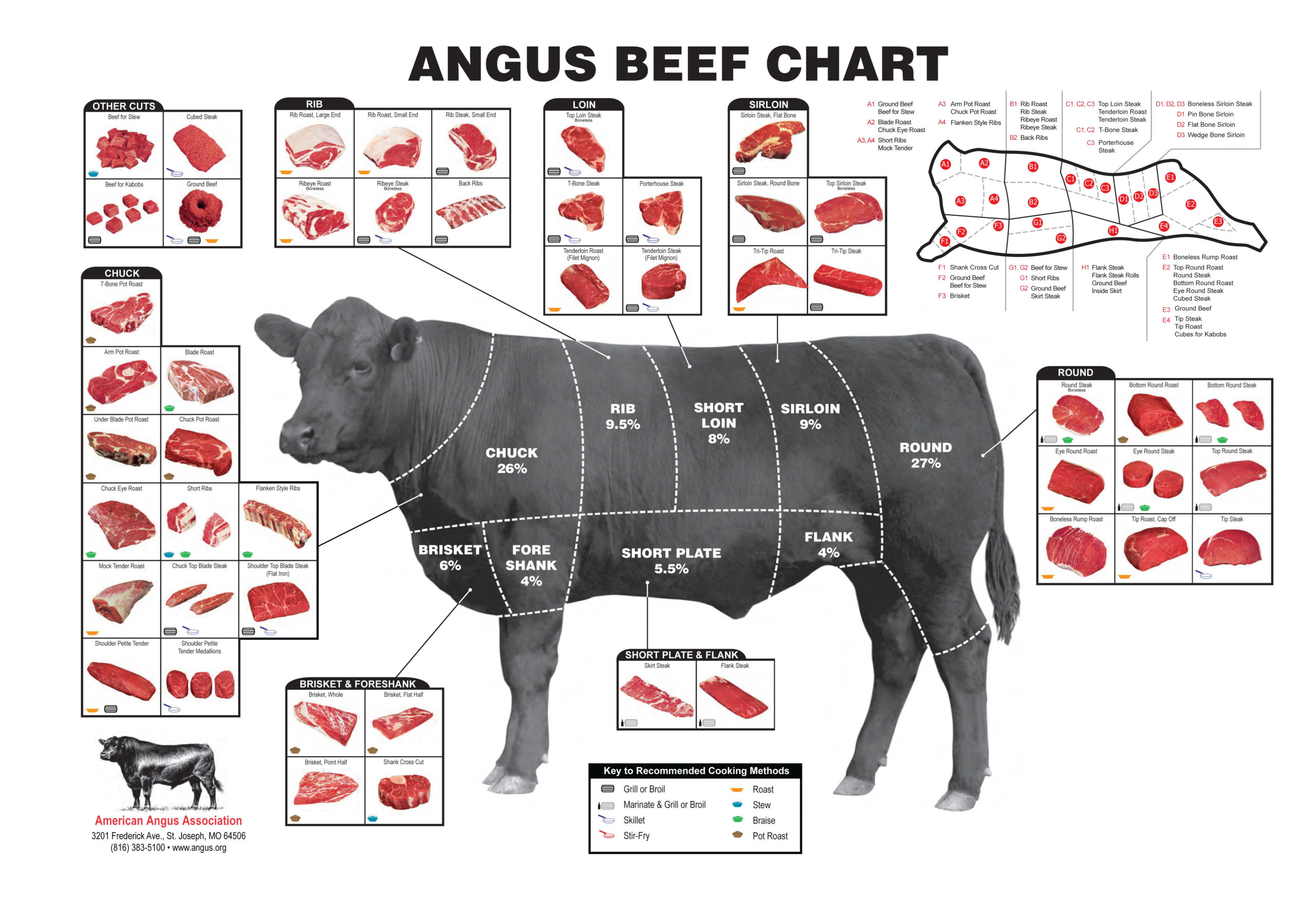
Click On the Image Above For a Larger PDF Version
"I've bought grass-fed beef before directly from ranchers. In the past I never really got a choice of the cuts I wanted. It was just a standard cut available. We don't cook roasts and briskets, so we always had things left over in the freezer that we didn't use. With DSR, Heather made sure that we got all the cuts we wanted, and we were able to get the roasts cut into stew and kabob meat, and extra ground beef, which we do use. Not a scrap of beef left over this year. Thanks guys."
Billy S – Albuquerque, NM
We consider our high-quality grass-fed beef to be a premium product that meets or exceeds the definition of the U.S. Department of Agriculture Prime beef grade. Beef is graded Prime when produced from young cattle that are well-fed and have moderate to abundant marbling.
Our steers are brought in for harvest at 16 months of age and a live weight of approximately 1,000 – 1,100lbs. They are available in quarters, halves and wholes and your cuts of meat are completely customizable when ordering a half or whole. A quarter beef must have the same cuts as another quarter when being processed and therefore has limited customization options.
With our program, we will personally assist you to customize your cut sheet for the processor to make sure you get the cuts of meat that are best for you.
Below are examples when using a standard cut on a whole, half and quarter beef. All cuts are professionally double wrapped and frozen. Each cut is clearly marked as to the cut of beef on the outside of the package.
Whole Beef:
- A whole beef will typically have a hang weight of approximately 500lbs.
- A final cut and wrapped weight of approximately 360lbs.
- Requires a freezer approximately 14-16 cubic feet.
- Will make approximately 240 meals for a family of 4.
- Will supply a family of 6+ for 18 months on average.
- Custom cut to your specifications.
- Packaging accommodations can be made for multiple parties.
Includes – when using a standard cut
- 18-20 T-Bone Steaks (3/4″)
- 18-20 Rib Steaks (3/4″)
- 10-12 Sirloin Tip Steaks (3/4″)
- 10-12 Sirloin Steaks (3/4″)
- 12-14 Round Steaks (1/2-3/4″)
- 10-12 Chuck Steaks (1/2-3/4″)
- 6 Arm Steaks (3/4″)
- 4 Chuck Roasts (3-4lbs each)
- 2 Arm Roasts (3-4lbs each)
- 14-18 Short Ribs
- 2 Brisket (6-8lbs each)
- 6 Rump Roasts (3-4lbs each)
- 75-85 Lbs. Ground Beef – (2lb packages)
- In addition, there are soup bones, liver, heart, tongue, and kidneys if the customer chooses.
Half Beef:
- A half beef will typically have a hang weight of approximately 250lbs
- A final cut and wrapped weight of approximately 180lbs.
- Requires a freezer approximately 7-8 cubic feet.
- Will make approximately 120 meals for a family of 4.
- Will supply a family of 4 for 12 months on average.
- Custom cut to your specifications.
- Packaging accommodations can be made for multiple parties.
Includes – when using a standard cut
- 8-10 T-Bone Steaks (3/4″)
- 8-10 Rib Steaks (3/4″)
- 4-6 Sirloin Tip Steaks (3/4″)
- 4-6 Sirloin Steaks (3/4″)
- 4-8 Round Steaks (1/2-3/4″)
- 5-6 Chuck Steaks (1/2-3/4″)
- 3 Arm Steaks (3/4″)
- 2 Chuck Roasts (3-4lbs each)
- 1 Arm Roasts (3-4lbs)
- 7-10 Short Ribs
- 1 Brisket (6-8lbs)
- 3 Rump Roasts (3-4lbs each)
- 35-45 Lbs. Ground Beef – (2lb packages).
- In addition, there are soup bones, liver, and kidneys if the customer chooses. *Please note, on a half beef the heart and tongue cannot be split. Let us know if you need a full heart or tongue. Normally arrangements can be made.
Quarter Beef:
- A quarter beef will typically have a hang weight of approximately 125lbs
- A final cut and wrapped weight of approximately 90lbs.
- Requires a freezer approximately 3-5 cubic feet.
- Will make approximately 60 meals for a family of 4.
- Will supply a family of 4 for 6+ months on average.
- Limited customization options.
- Steaks are individually packaged
- Ground beef are in 1lb packages
Includes
- 4-5 T-Bone Steaks (3/4″)
- 4-5 Rib Steaks (3/4″)
- 2-3 Sirloin Tip Steaks (3/4″)
- 2-3 Sirloin Steaks (3/4″)
- 2-4 Round Steaks (1/2-3/4″)
- 2-3 Chuck Steaks (1/2-3/4″)
- 1 Chuck Roasts (3-4lbs each)
- 4-5 Short Ribs
- 1 Brisket (3-4lbs)
- 1-2 Rump Roasts (3-4lbs each)
- 25-27 Lbs. Ground Beef – (1lb packages).
- In addition, there are soup bones upon request.
*Please Note: a quarter beef must have the same steak cuts as another quarter when being processed and therefore has limited customization options. Roasts can be ground for customers who want additional ground beef.
A guide to beef cuts
We are happy to guide you through the process of deciding your beef cuts. However, before indicating your cut instructions, you will want to have an idea of what kind of cuts you like and those that you do not care for so much. Think of the ways you normally eat beef:
- Is your family a steak and potatoes type family with a portion of meat for each person?
- Are you the type to use beef as an ingredient in a meal like tacos and casseroles?
- Does your family use ground beef frequently in meal planning? How many pounds do you tend to prepare each serving?
- How frequently do you cook a roast?
- Do you prepare meals using stew meat, short ribs, or soup bones?
- Would you be interested in receiving any of the organs (beef liver, heart, kidney or tongue)?
Knowing the types of cuts you enjoy the most is only helpful to a point, as a side of beef is only going to have so many of each type of cut. Also keep in mind the thickness of the cut will determine how many cuts you may get from each, like steaks for example.
In the U.S. a beef is divided up into 9 cuts, which are large sections of meat that are further broken down into retail cuts, like steaks and roasts.
CHUCK
This cut encompasses the neck, shoulder and part of the upper arm. These muscles do a lot of work, and there is a good deal of connective tissue which makes it an excellent choice for braising and slow cooking.
BRISKET
This cut from the chest of the beef is very tough and should be cooked long and slow. Crockpot is an excellent choice. The brisket is used in corned beef and barbeque brisket, but can be cooked as a pot roast.
What are my options: Roasts or grind for ground beef.
RIB
This cut is one of the more tender sections of beef. Located along the ribs, this is the source of a standing rib roast, also called a "prime rib," though that term refers to a grade of beef not a specific cut.
What are my options: Roast (bone-in or boneless) or steaks (bone-in steaks = rib steaks, boneless = ribeye)
PLATE
A smaller cut from the belly of the beef. This is the source of short ribs and skirt steaks.
What are my options: Short ribs, skirt steaks or grind for ground beef.
LOIN CUTS
The three cuts of the loin are the most tender cuts of beef. They are: short loin, sirloin, and tenderloin.
Short Loin
The short loin is where the T-Bone steak comes from. On one side of the T is the New York strip steak and the other side is the tenderloin/filet.
What are my options: T-Bone steaks or NY strip and tenderloin.
Sirloin
A leaner portion of the loin, this muscle group is the source of sirloin steaks.
What are my options: top sirloin steaks
Tenderloin
The most tender muscle, a portion of the tenderloin extends into the short loin (T-Bone steaks), but the remaining tenderloin can be cut up into tenderloin (also called filet mignon) steaks or left whole as a roast.
What are my options: tenderloin steaks or roast
ROUND
This is a very lean muscle group that does a lot of work and requires moist heat or careful cooking. The round, both top and bottom, can be cut into steaks. The boneless rump roast also comes from this cut as well as the sirloin tip roast (which is not part of the loin cut at all but from the hip which is in the round cut).
What are my options: steaks, stew/kabob meat, roasts, or grind for ground beef.
*Note: The round is a common source of cube steaks (top or bottom round) run though a tenderizing machine to slash the muscle fibers to make a quick cooking steak (chicken-fried steak and applications like stir-fry).
FLANK
With the exception of the flank steak, most all of the flank cut is ground into hamburger. The other muscles are just too small for anything else.
What are my options: flank steak or grind for ground beef.
FORE SHANK
The shank, or upper portion of the leg, is a very tough cut of meat but full of wonderful flavor.
What are my options: grind for ground beef.
Source: https://dsrcattle.com/beef-sizes-and-cuts/
0 Response to "How Much Is 8lbs of Beef"
Post a Comment